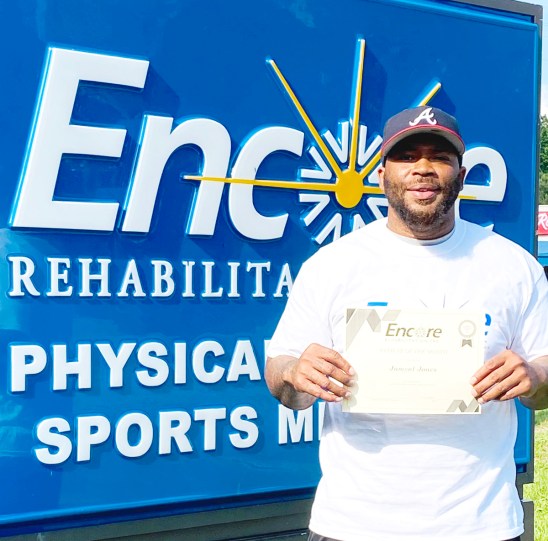
“I recently tore my rotator cuff in the gym working out. During my time at Physical Therapy, I’ve been looking forward to getting back to working out. The wonderful staff at Encore Rehabilitation-Luverne has done a great job helping me get back to myself with my strength and muscle endurance. I’m so glad I chose Encore to help me with this process because they have been nothing short of excellent! The one-on-one Physical Therapy I received was exceptional and was worth every ounce of pain I endured through this process. I chose Encore because the clinic was close by. I knew it would be family-oriented and that makes the experience and rehab a lot more comfortable and easier. Thanks greatly to the entire staff for being courteous and very professional.“~ Jamyal Jones, patient
Thank you, Jamyal, for choosing Encore to be your rehab partner! We are proud to select you as our Patient of the Month. You have done a great job with your rehab! Enjoy the gym!
We LOVE helping people get back to doing the things they enjoy! If rehab is in your future, call Encore!
We’ve all experienced strains, cramps, soreness, and general tightness, but it doesn’t help that these all seem to cause varying degrees of similar pain. Here’s how to tell if it’s really a pulled muscle and what you can do about it.
Sharp pain in general is a pretty fair indicator of something nasty, but it’s also very complex. You’d probably be busy worrying about whether you can or should continue working out, either a bit later or in the days after. So, it’s important to determine that you do have a pulled muscle and not some other type of pain, like our good friend delayed-onset muscle soreness (DOMS). It’s a very simple but common mistake. Luckily, there are a couple of things to look out for.
Is It Really A Pulled Muscle?
When you pull a muscle, it usually happens suddenly, and you’ll know something’s gone horribly wrong in that instant. Because a pulled muscle can be easily confused with other types of injuries like sprains or hernias, a major differentiator, according to Paul Ingraham, science writer at PainScience.com, is that a muscle strain makes just onemuscle (or muscle group) feel weak and the muscle contraction painful.
Basically, you’d feel more pain during the lengthening (eccentric) portion of the movement and during resistance tests, says Justin Kobbe Solace, a board certified massage therapist and pain management specialist at Hybrid Health. In more severe cases, there’ll be signs of inflammation, like swelling, redness, and warmth on the skin, and possible bruising. At that point, don’t try to play it cool; get some medical help.
How to Prevent Future Muscle Strains
You’ve probably heard the advice to stretch and generally keep yourself “flexible”, and you won’t strain your muscles. However, a review of the research into the topic shows that regular stretching doesn’t help keep you from pulling a muscle (or preventing injuries in general). So, what does work? A good warm-up, but keep in mind an effective warm-up doesn’t necessarily include static stretching.
Know when you’re ready to go again: Going back to your regular workouts should be based on the return of your strength and range of motion, rather than by a set recovery period. Of course, this will vary depending on the severity of the strain, but the key is to keep things pain-free. When you do get back to it, slowly ramp up the intensity week-by-week according to how your injury feels.
Minimize intense activity when you’re really tired: You are much more prone to any sort of injury when you’re tired or fatigued, so don’t try to push through workouts, especially if your form, alertness, and technique start to fall off.
Start slow: If you’re starting a new program, exercise, or sport, it’s important to ease yourself into it so you can learn to recognize when you should push or back off.
The good news is that our bodies are amazingly resilient, and we can make them stronger. Of course, it’ll take effort. In the case of rehabilitation from a serious injury, professional supervision by a physical therapist, trainer, or doctor is necessary to make sure you’re doing your exercises and stretches correctly to strengthen and keep an injured muscle healthy.
Stretching Does More Harm Than Good
Your first instinct might be to stretch a pulled muscle, but think about it for a second: if a pulled muscle is a result of overstretching, then stretching it further to its full range of motion won’t help. Instead, your safest bet is to simply avoid anything that would agitate the injured muscle and give it as many days as it needs to calm down.
The universally recommended initial treatment for pulled muscles is R.I.C.E., which stands for rest, ice, compression, and elevation. No surprise there, as it seems to be the framework for many other soft-tissue injuries as well. Interestingly, though, the authors of this paper in the Journal of the American Academy of Orthopaedic Surgeons and this one in the Journal of Athletic Trainingmention that the efficacy of I.C.E. in R.I.C.E. for muscle strains in particular haven’t been fully studied. Still, “their employment is generally recommended.”
That’s to say that icing, compression, and elevation probably don’t treat the actual strain, but icing and compression can help numb the pain at least.
If you grit your teeth and exercise through the pain too soon, you might end up making the injury worse, which could eventually lead to re-injury or chronic injury, says Solace. If it’s a minor strain, do what you can as far as gently moving your muscle through its range of motion after a couple of days of rest. Stop if or when it’s painful. Solace adds that this way, you encourage blood flow to aid in the healing process.
Article by Stephanie Lee, Illustration by Fruzsina Kuhari. Article found at http://vitals.lifehacker.com/what-to-do-when-you-pull-a-muscle-from-working-out-1759172514. This article is a suggestion by Encore Rehab not specified medical advice.


 Encore Rehabilitation, Inc.