Encore Rehab.

Hartselle Encore Athlete of the Month, Madelyn Cheatham.

 Screen Shot 2014-06-27 at 1.37.50 PM

Congratulations to Madelyn Cheatham for being chosen as the Hartselle Encore Athlete of the Month! Madelyn is a 6’1″ (Or 5’13” as she says it) Junior at Hartselle High School, and plays vollyball for the Lady Tigers, as well as travel ball for RCVC out of Huntsville. She hopes to play volleyball on scholarship for the University of Alabama after graduation.

“How do I know if I have a Concussion?” – Signs and Symptoms of concussions in adults and children.

At the ATC conventions many of the topics are around concussions; “how do you properly diagnose an athlete with a concussion?” “What are the signs and symptoms?” We wanted to help inform athletes, parents, and coaches on what exactly a concussion entails and what to do if you think you have one. Below are two lists, one for adults and one for children, that will help you be able to recognize the signs of a concussion.  If you have signs of a concussion, please see a doctor immediately for further instruction and proper procedures. 

*These two lists can be found at WebMD.com and MayoClinic.org.

“It is not always easy to know if someone has a concussion. You don’t have to pass out (lose consciousness) to have a concussion. Symptoms of a concussion range from mild to severe and can last for hours, days, weeks, or even months. If you notice any symptoms of a concussion, contact your doctor.” – WebMD

Symptoms of a concussion fit into four main categories:

  • Thinking and remembering
    • Not thinking clearly
    • Temporary loss of consciousness
    • Feeling slowed down
    • Not being able to concentrate
    • Not being able to remember new information
    • Delayed response to questions*
    • Slurred speech*
  • Physical
    • Headache or feeling of pressure of the head
    • Fuzzy or blurry vision
    • Nausea and vomiting
    • Dizziness
    • Ringing in the ears
    • Sensitivity to light or noise
    • Balance problems
    • Feeling tired or having no energy
  • Emotional and mood
    • Easily upset or angered
    • Sad
    • Nervous or anxious
    • More emotional
  • Sleep
    • Sleeping more than usual
    • Sleeping less than usual
    • Having a hard time falling asleep

Symptoms in Young children:

  • Crying more than usual.
  • Headache that does not go away.
  • Changes in the way they play or act.
  • Changes in the way they nurse, eat, or sleep.
  • Being upset easily or having more temper tantrums.
  • A sad mood.
  • Appearing dazed
  • Lack of interest in their usual activities or favorite toys.
  • Loss of new skills, such as toilet training.
  • Loss of balance and trouble walking.
  • Not being able to pay attention.

Sources:

 “Concussion – Overview.” . Healthwise, Incorporated, 29 Nov. 2011. Web. 25 June 2014. <http://www.webmd.com/brain/tc/traumatic-brain-injury-concussion-overview&gt;.

Mayo Clinic Staff. “Concussion Symptoms.” . N.p., 2 Apr. 2014. Web. 25 June 2014. <http://www.mayoclinic.org/diseases-conditions/concussion/basics/symptoms/con-20019272&gt;.

Great Article! “The One Exercise That Just Might Change Your Running Forever” via the Huffington Post.

“What if all it took to improve your running immeasurably was a few minutes marching in place?

In a 2011 New York Times Magazine feature, Christopher McDougall, author ofBorn to Run: A Hidden Tribe, Super Athletes and the Greatest Race the World Has Never Seen experimented with just that.

“I was leafing through the back of an out-of-print book, a collection of runners’ biographies called ‘The Five Kings of Distance,’ when I came across a three-page essay from 1908 titled ‘W. G. George’s Own Account From the 100-Up Exercise,’” he writes. “According to legend, this single drill turned a 16 year old with almost no running experience into the foremost racer of his day.”

Walter Goodall George’s earliest sporting interests were rugby and cycling, but he went on to win over 1,000 amateur prizes and races and set long-standing records as a professional runner. “He became unbeatable over the middle distances in an era before training became scientific,” the Oxford Dictionary Of National Biography writes, all while pioneering his own personal brand of “scientific” training, namely the 100-Up. In 1878, at age 19, he wrote a plan to break the then-world record for the mile — and proceeded to run nearly exactly his plan’s predicted time in 1886. In addition to his 100-Up essay cited by McDougall, he also published a short book on the exercise in 1913, according to the Oxford DNB.

George’s 100-Up routine is divided into two parts, the minor and the major. The minor involves standing with both feet about eight inches apart “and your arms cocked in running position,” McDougall writes. Then, raise one knee at a time to hip height, bringing it back down lightly to its original position. All that’s left after that is to repeat this movement 100 times. The major involves the same movement at a higher speed. McDougall quotes George: “The body must be balanced on the ball of the foot, the heels being clear of the ground and the head and body being tilted very slightly forward…. Now, spring from the toe, bringing the knee to the level of the hip…. Repeat with the other leg and continue raising and lowering the legs alternately. This action is exactly that of running.”

Sounds a little too simple, no?

Experienced runners will likely recognize these movements as the tried-and-true running drill commonly referred to as high knees, a simple way to up strength and endurance of the hip flexor and quad, according to New York Road Runners (NYRR). Straightforward as it looks, high knees –and other running drills — canhelp you become a better runner, says NYRR coach John Honerkamp. The 100-Up is essentially exaggerated running form, and performing 100 repetitions can help build muscle memory during a similar state of fatigue that a runner might experience at the end of a tough workout or a grueling race, he says.

But it’s the focus on form that’s most important. “You’re reinforcing poor form if you’re doing it improperly,” says Honerkamp. “Once you stop doing it correctly, you shouldn’t do it at all.” That means concentrating not just on returning each foot to its starting point, but paying attention to arm swing, keeping the core stable and landing close to your center of gravity on the balls of your feet every single time, he says. For most 100-Up beginners, 100 reps is a long-term goal. Aim to start with maybe 20 repetitions instead — or however many you can complete with perfect form.

Don’t expect to see immediate results, either, Honerkamp warns. Running on your toes, typically considered more efficient because you’re spending less time on the ground, may be the end goal, but heel strikers need to ease into adaptations. “I worry about people trying to drastically change,” says Honerkamp. “It’s something to work on and think about, but don’t over-think or overcorrect,” he says.

Whether or not you devote yourself to the 100-Up for life or simply dabble in running form drills periodically, incorporating focus on form into a warmup or regular training routine is a good idea, says Honerkamp. “People skip [warmups] because they’re busy getting out of the door,” he says, “but five minutes probably will go a long way.”


Source: Klein, S. (2014, June 4). The One Exercise That Just Might Change Your Running Forever. . Retrieved June 20, 2014, from http://www.huffingtonpost.com/2014/06/04/100-up-running_n_5406664.html

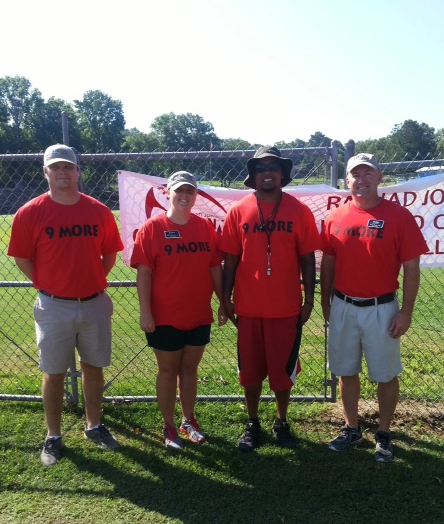
Encore ATC’s were proud to cover Rashad Johnson’s 4th Annual Free Youth Camp this year!

 Rashad Johnson's 4th Annual Free Youth Camp

Encore ATC’s were proud to covered Rashad Johnson‘s 4th Annual Free Youth Camp at Sulligent High School, June 13th and 14th!

Pictured left to right:
Ryan Cooke, Nikki McBrayer, Rashad Johnson and Drew Battle. 

Congratulations to Sara Long, Fayette Clinic Athlete of the Month.

Image

Congratulations to the Fayette Clinic Athlete of the Month, Sara Long.  Sara is a Junior at South Lamar High School and played on the high school’s volleyball team, as well as the club volleyball team.  She plans to attend Bevill State for two years and then transfer to the University of Alabama to major in Criminology.  Sara is the daughter of Jeff and Mary Long. 

Stiff back? Here are some stretches you can do to help relieve the pain.

“General Tips for Stretching to Relieve Back Pain

Keep the following in mind when starting a stretching routine as part of a program of back exercises:

  • Wear comfortable clothes that won’t bind
  • Stretching should be pain free; do not force the body into difficult positions
  • Move into the stretch slowly and avoid bouncing, which may actually tear muscles
  • Stretch on a clean, flat surface that is large enough to move freely
  • Hold stretches long enough (20-30 seconds) to allow muscles or joints to become loose
  • Repeat the stretch, generally 5-10 times

If one already has low back pain or neck pain, it is best to check with a physician or physical therapist to discuss whether the following neck, shoulder, and lower back pain exercises should be done.

Back Exercise Stretches

Many back pain patients know the feeling of tension in the back, especially first thing in the morning. These stretching back exercises can help bring back some suppleness and increase mobility, decreasing back pain and discomfort.

Back Flexion Exercise
While lying on one’s back, pull both knees to the chest while simultaneously flexing the head forward until a comfortable stretch is felt in a balled-up position. (See left Figure 8)

Knee to Chest Stretch
While lying on the back with the knees bent and both heels on the floor, place both hands behind one knee and bring it to the chest. (See right Figure 21)”

Source: Ulrich Jr., P. (2999, September 8). Stretching for Back Pain Relief. Retrieved , from http://www.spine-health.com/wellness/exercise/exercise-and-back-pain

A few at home remedies for mild Carpal Tunnel syndrome.

Carpal tunnel syndrome is numbness, tingling, weakness, and other problems in your hand because of pressure on the median nerve in your wrist.  The median nerve and several tendons run from your forearm to your hand through a small space in your wrist called the carpal tunnel. The median nerve controls movement and feeling in your thumb and first three fingers (not your little finger).

Symptoms most often occur in the thumb, index finger, middle finger, and half of the ring finger. If you have problems with your other fingers but your little finger is fine, this may be a sign that you have carpal tunnel syndrome. A different nerve gives feeling to the little finger.”

Mild symptoms usually can be treated with home care. You can:

  • Stop activities that cause numbness and pain. Rest your wrist longer between activities.
  • Ice your wrist for 10 to 15 minutes 1 or 2 times an hour.
  • Try taking nonsteroidal anti-inflammatory drugs (NSAIDs) to relieve pain and reduce swelling.
  • Wear a wrist splint at night. This takes pressure off your median nerve.

“The sooner you start treatment, the better your chances of stopping symptoms and preventing long-term damage to the nerve.”

You can also try to take good care of your wrists and hands:

  • Try to keep your wrist in a neutral position.
  • Use your whole hand—not just your fingers—to hold objects.
  • When you type, keep your wrists straight, with your hands a little higher than your wrists. Relax your shoulders when your arms are at your sides.
  • If you can, switch hands often when you repeat movements

Source: Carpal Tunnel Syndrome – Topic Overview. (2012, October 2). . Retrieved May 21, 2014, from http://www.webmd.com/pain-management/carpal-tunnel/carpal-tunnel-syndrome-topic-overview

Encore Photo Contest Winners!

Encore had a company wide photo contest last week and we wanted to share the beauty of these photos with you! The objective was to capture a landmark that best represents the town the photographer was from. 
The winners are as follows: 
1) Brett Ferguson, LPTA – Muscle Shoals Bridge

Image

2) Emily Perez, OT – Winter Fountain

Image


3) Beth Farris- Fayette Courthouse

Image

Decatur Encore Athlete of the Month, Madeline Johnson

Image

Congratulations to Madeline Johnson, Senior at Decatur High School. She has been a cheerleader for six years and has been on the Decatur varsity cheerleading team for two years. Madeline is an All American Cheerleader with a UCA staff application. She is also an instructor at southern spirit and a member of their competitive team. Madeline will attend UNA this fall on scholarship.