Encore Rehab.

Winfield Encore Athlete of the Month, Garrett Cooper!

IMG_7859.jpg

Congratulations to the Winfield Encore Athlete of the Month, Garrett Cooper! Garrett is a senior athlete at Marion County High School. He is a member of the Track and Cross Country team and has ran on varsity for 6 years. Garrett has won the Track All-County, award, All-Section award, All-State Pole Vault, and 2nd and 3rd place in pole vault at the State Indoor track meet! After college, Garrett plans to attend the University of Alabama to study Architectural Engineering. He is the son of David and Joy Cooper.

Gordo Encore Athlete of the Month, Cliff Morton.

Screen Shot 2016-08-24 at 10.47.42 AM.png

Congratulations to the Gordo Encore Athlete of the Month, Cliff Morton! Cliff is a junior athlete from Pickens County High School. He has played on the Basketball and Baseball teams for 4 years now and wears jersey #5. Cliff has won the Hustle Award for Baseball and MVP for JV Basketball. After graduation, Cliff plans to attend college to become an RN. Cliff is the son of Greg and Anissa Morton.

East Central Athlete of the Month, Eric Saksa.

Congratulations to the East Central Athlete of the Month, Eric Saksa!

Eric is a sophomore athlete at Pearl River Community College in Poplarville, Mississippi. He is on the Wildcats Varsity Baseball team and wears jersey #14. He has a 3.5 GPA and is majoring in Pre-medical sciences. He is the son of Mike and Tonya Saksa. Good luck during baseball season, Eric! Go Wildcats!

Fayette Encore Athlete of the Month, Austin Hattaway.

Congratulations to the Fayette Encore Athlete of the Month, Austin Hattaway! Austin is a senior athlete at Fayette County High School. He has played on the Varsity Baseball team for 3 years and wears jersey number 7. After graduation next spring, Austin plans to attend college to major in sports medicine. He is the son of Jessica and Justin Freeman.
Keep up the good work, Austin! Good luck your senior year!

FAST-TWITCH & SLOW-TWITCH MUSCLES: What muscle fiber types will take an athlete from good to great?


“Looking to build endurance? What about power? Do dreams of being an all-star hitter or marathon runner need to be dashed if twitch ratios aren’t ideal? Not necessarily. The types of muscle fibers targeted in different types of training programs can impact performance goals.”

“As most of us may recall from our physiology studies, there are two main types of human skeletal muscle fiber types, type I and type II, or slow-twitch and fast-twitch, respectively. Fast-twitch are further classified into type IIa and type IIx. They differ in both their biochemical and contractile properties.”

Slow-twitch, Type I

“These muscle fibers have high concentrations of mitochondria and myoglobin, and although they are smaller than the fast-twitch fibers, are surrounded by more capillaries (1,2). This combination supports their capacity for aerobic metabolism and fatigue resistance, particularly important for prolonged submaximal exercise activities. Type I fibers produce less force, are slower to produce maximal tension (lower myosin ATPase activity) compared to type II fibers, but they are able to maintain longer-term contractions, key for stabilization and postural control (1,2).”

Fast-twitch, Type II

“Our fast-twitch, type II muscle fibers are further divided into type IIx and type IIa. Typically, these have lower concentrations of mitochondria, myoglobin, and capillaries compared to our slow-twitch fibers and are quicker to fatigue (1,2). These larger-sized fibers are also able to produce a greater and quicker force, an important consideration for power activities (1,2).”

  • Type IIx: These fibers produce the most force, but are incredibly inefficient based on their high myosin ATPase activity, low oxidative capacity, and heavy reliance on anaerobic metabolism (1,2).
  • Type IIa: These fibers are also known as intermediate fibers, a mix if you will, of type I and type IIx, with comparable tension. Able to use both aerobic and anaerobic energy systems, these fibers have a higher oxidative capacity and fatigue more slowly than type IIx (1,2).

What’s my type?

“So now that we’ve covered the different types, are you wondering what type you are? Short of having a muscle biopsy, and make that multiple biopsies since not all muscles in the body will be the same, we are a mix of both fast and slow in all of our muscles (1). Nonathletic individuals have close to a 50/50 balance of fiber types. When you start looking at highly skilled, top-performing athletes, some differences may begin to appear. For the power athlete, there’s a higher ratio of fast-twitch fibers (e.g., sprinters 70-75% type II), whereas for the endurance athlete there are more slow-twitch fibers (e.g., marathon/distance runners 70-80% type I) (2). Of course, muscle fiber type is not the only factor in an athlete’s success! There are plenty of other variables that take an athlete from good to great.”

“Age is also a factor for our muscle fibers. As we age, there’s a loss in lean muscle mass, with a decline in our fast-twitch fibers, especially the type IIx, but there is also an increase in our slow-twitch fibers (2-4). Recall that the fast-twitch fibers are larger in size than the slow-twitch, metabolically efficient fibers. This loss of lean muscle mass can contribute to age-related metabolic dysfunctions, body composition changes, even an increased risk of falls (2-5). Resistance training can help combat this decline.”

Type Training

“Fiber types can be modified to some degree by exercise. Type I fibers are targeted with endurance training, such as lower resistance with higher repetitions, or longer duration with a lower intensity, as seen in OPT ™ Phases 1 and 2 (7,8). Strength training targets the type II fibers. Resistance training increases the size of both type I and type II muscle fibers, with greater growth (i.e., hypertrophy) occurring in the type II fibers with an increase in actin and myosin filaments, which also results in an increased ability to generate force (2). An increase in type IIx to type IIa, but not increase type I can also be seen in prolonged resistance training (2). Fast-twitch fibers can be slow-twitch recruits: endurance training and high-intensity intervals can be effective in improving aerobic power (2,6).”

Tapering during training programs (e.g., reducing volume and intensity) can also improve the strength and power of type IIa fibers, without a decrease in type 1 performance (9). For example, in a study investigating muscle fiber changes in recreational runners training for a marathon, after 13 weeks of increasing mileage and a three week tapering cycle, it was found that not only did the functions of type 1 and type IIa fibers improve, but that type IIa continued to improve significantly during the tapering cycle (9).”


** This article was written by a NASM publisher. The full article can be found here

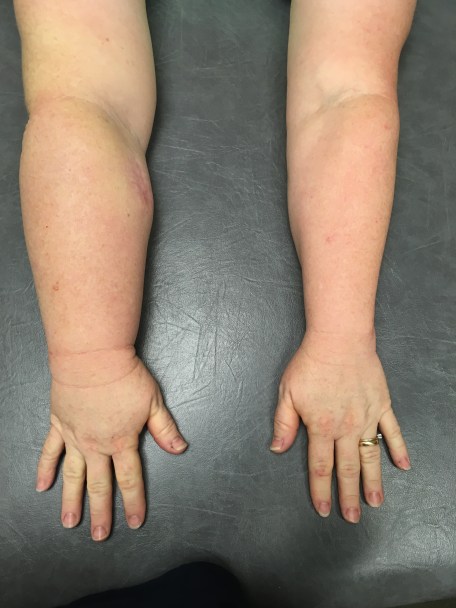
Risk of Lymphedema Following Cancer Interventions

Lymph arm.jpg

Lymphedema is an abnormal accumulation of protein and water that causes swelling, occurring most frequently in an arm or leg. Cancer interventions often damage portions of the lymphatic system and are the leading cause of lymphedema in the United States. The lymphatic system is a complex system made up of lymphatic fluid, lymph nodes, vessels, collectors, the spleen, and thymus. Its main functions are to drain substances that cannot be absorbed by the vascular system and also plays a role in your immune response.

Surgical procedures such a mastectomy, lumpectomy, or lymph node resection remove or damage lymph nodes in the affected region, decreasing your body’s ability to filter out this lymph fluid. Radiation treatment also poses a threat for lymphatic system damage. Since lymphatic vessels are mere millimeters beneath the surface of the skin, scar tissue formation along radiation treatment areas can impair lymphatic flow through these vessels. These cancer interventions compromise the lymphatic system which significantly increases the risk of developing lymphedema.

According to the Academy of Lymphatic Studies’, 50-75% of patients that have undergone a mastectomy secondary to breast cancer acquire lymphedema within 5 years. Any cancer that requires surgical intervention and/or radiation on or near the neck, armpit, or groin are also at an increased risk of developing lymphedema. Examples include the following: Breast, prostate, uterus, bladder, lymphoma, and melanoma. Although the majority of lymphedema diagnoses are secondary to cancer, lymphedema may also occur secondary a congenital malformation of the lymphatic system (primary lymphedema) or secondary to trauma, infection, malignant tumors, or chronic venous insufficiencies.

Early detection and management of lymphedema is key! Recognizing these early symptoms and talking with your doctor can ensure you receive proper lymphedema treatment and obtain adequate education and tools needed to manage your diagnosis.

Early signs and symptoms of lymphedema include the following and may come and go at first:

    • Swelling in all or part of the affected region – pressing on the skin with your finger may leave an indentation, which is called pitting edema
    • Abnormal feeling in the extremity, such as tingling, numbness, tight feeling, heavy felling, or just that something doesn’t feel right
    • Rings or clothing fitting differently
    • Veins or tendons harder to distinguish

Regardless of whether lymphedema was caused by cancer interventions or by another source, it is important to know that there are trained therapists nearby that can assist you in understanding your diagnosis. The current gold standard for lymphedema treatment is Complete Decongestive Therapy (CDT) which consists of manual lymphatic drainage (MLD), compression bandage application, decongestive exercises and skin care. CDT is available locally at the Neuroscience Center in Ocean Springs and at the Medical Park in Pascagoula.

For additional information, please come to one of our free educational meetings held on the 3rd Wednesday of each month on the 2nd floor of the Neuroscience Center in Ocean Springs (building right next door to the Cancer Center).

This article was written by Jaime Garrett, MS, OTR/L for Encore Rehabilitation in Ocean Springs, Mississippi. 

Fairfield Encore Athlete of the Month, Jaylon Finley.

Jaylon Finley.png

Congratulations to the Fairfield Encore Athlete of the Month, Jaylon Finley! Jaylon is a sophomore athlete at Fairfield high school. She has been a member of the varsity cheerleading team since 6th grade and will graduate in 2019. After high school, Jaylon plans to attend college to major in Dental Hygiene or Criminal justice. She is the daughter of Kieawonna Dortch. Keep up the good work Jaylon!

Columbus Patient of the Month, John Earhart

John Earhart.JPG

Mr. Earhart with Erin Mahony, PTA.

We would like to congratulate our Columbus Patient of the Month, John Earhart! Mr. Earhart came to us with low back and hip pain after having a total hip surgery a few years ago. We have been treating him with physical therapy for 3 months now and he just finished his physical therapy program with us yesterday! He has been a pleasure to work with. His smile and jokes make everyone’s day better and he is always willing to do what is asked of him.


Tuscan Avenue Encore Athlete of the Month, Deonta Pittman.

Screen Shot 2016-07-27 at 3.08.23 PM.png

Congratulations to the Tuscan Avenue Encore Athlete of the Month, Deonta Pittman! Deonta is a senior athlete at William Carey University University in Mississippi. He has been on the WCU Men’s Basketball team for 4 years now and has been awarded MVP of Southern State, SSAC First Team -All American, and has made it to the NAIA National Basketball Tournament. After graduation, Deonta will further his basketball career professionally and also have a physical education degree. He is the son of Linda Pittman and Don Lewis.

Diamondhead Encore Athlete of the Month, Erica Ladner.

9965.jpeg

Congratulations to the Diamondhead Encore Athlete of the Month, Erica Ladner! Erica is a recent graduate from Hancock High School in Kiln, MS and was a member of the Lady Hawks Varsity Softball team for 5 years. She wore jersey #8 and completed high school with a 3.9 GPA. She is attending college this fall in hopes to be accepted into nursing school to become a registered nurse. She is the daughter of Marisha Nores.