Uncategorized

PT Tip of the week: Osteoarthritis


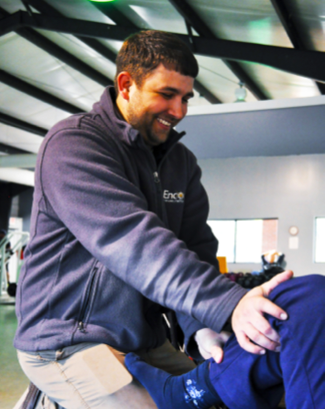
Jack Dockery, PT, DPT – Encore Clinic at Tillman’s Corner.

“As a physical therapist, I commonly encounter patients that have been diagnosed with osteoarthritis of the knee joint and want to know what they can do to avoid or postpone a total joint replacement. Obesity is a modifiable risk factor that has a direct correlation with the development of knee joint osteoarthritis, being that the knee is a weight bearing joint. A quick and easy means to determine a personal weight problem is the Body Mass Index (BMI). An individual can calculate his/her BMI by dividing their mass in kilograms by their height in meters squared. If this number is greater than 30.0 than that person will fall into the obese category and have a higher risk of developing knee osteoarthritis. Exercise is also important in avoiding or postponing a total joint replacement by strengthening the muscles around the joint and normalizing muscle imbalances. Low impact exercises such as aquatics, cycling, walking, and stretching are ideal for an arthritic joint by dissipating less joint force than higher level exercises such as running and jumping. Lastly, when running or jogging an individual should be doing so in appropriate footwear. Most individuals would benefit from a foot orthotic placing the foot in anatomical position and avoid placing other joints in the lower leg at a mechanical disadvantage. A person should change their shoes with an increase in lower leg or back pain and/or breakdown of the midsole.”


Encore Photo Contest Winners!

Encore had a company wide photo contest last week and we wanted to share the beauty of these photos with you! The objective was to capture a landmark that best represents the town the photographer was from. 
The winners are as follows: 
1) Brett Ferguson, LPTA – Muscle Shoals Bridge

Image

2) Emily Perez, OT – Winter Fountain

Image


3) Beth Farris- Fayette Courthouse

Image

Decatur Encore Athlete of the Month, Madeline Johnson

Image

Congratulations to Madeline Johnson, Senior at Decatur High School. She has been a cheerleader for six years and has been on the Decatur varsity cheerleading team for two years. Madeline is an All American Cheerleader with a UCA staff application. She is also an instructor at southern spirit and a member of their competitive team. Madeline will attend UNA this fall on scholarship. 

Ari Hallmark

Image

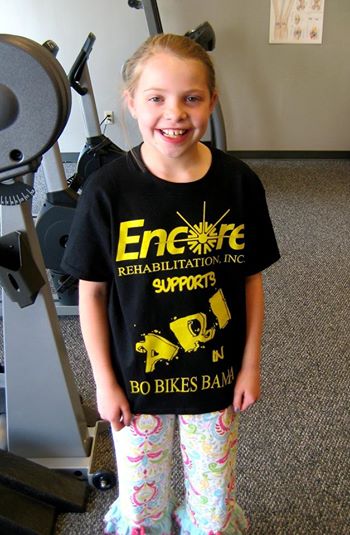
This post is dedicated to the beautiful Ari Hallmark, a survivor of the April 27th tornado in Ruth. Both her parents, grandparents and a cousin were killed in the tornado, and they found Ari 200 yard from where she was before the storm. She has written a book about her experience called, “ To Heaven After the Storm“. Tomorrow, Ari will be riding in the Bo Bikes Bama, on the bike Bo Jackson gave her. We support team Ari!!

ATC Tip of the week: Hydrogen peroxide vs Alcohol

Hydrogen peroxide should be used to debride a cut or scratch as soon as the injury occurs, and never again. Alcohol can be used to clean the wound the days following injury.

Hydrogen peroxide eats away cells and tissue to debride the injury. If used continuously it slows down healing time due to the damage it does to the new tissue being made to heal the wound.”

– Robert Milam M.Ed., A.T.C./L, Spanish Fort High School. 

Cullman Encore Athlete of the Month, Isaac Hardin

Image 

Congratulations to Isaac Hardin for being chosen as the Cullman Encore Athlete of the Month! Isaac is a Junior and plays baseball and football for Hanceville High School. He is the catcher and pitcher for the varsity baseball team, and plays center and middle linebacker for the varsity football team. Isaac has had a good baseball career with batting average of .352, 4 home runs, and 38RBIs. He would like to attend UAB after high school and play for the college baseball team. Good Luck Isaac!

Considering ACL Surgery?

ACL surgery Hayden Clinic Encore Rehab

Surgery for anterior cruciate ligament (ACL) injuries involves reconstructing or repairing the ACL.

  • ACL reconstruction surgery uses a graft to replace the ligament. The most common grafts are autografts using part of your own body, such as the tendon of the kneecap (patellar tendon) or one of the hamstring tendons. Another choice is allograft tissue, which is taken from a deceased donor.
  • Repair surgery typically is used only in the case of an avulsion fracture (a separation of the ligament and a piece of the bone from the rest of the bone). In this case, the bone fragment connected to the ACL is reattached to the bone.

ACL surgery is usually done by making small incisions in the knee and inserting instruments for surgery through these incisions (arthroscopic surgery). In some cases, it is done by cutting a large incision in the knee (open surgery).

ACL surgeries are done by orthopedic surgeons.

Many orthopedic surgeons use arthroscopic surgery rather than open surgery for ACL injuries because:

  • It is easy to see and work on the knee structures.
  • It uses smaller incisions than open surgery.
  • It can be done at the same time as diagnostic arthroscopy (using arthroscopy to find out about the injury or damage to the knee).
  • It may have fewer risks than open surgery.

Arthroscopic surgery is done under regional (such as spinal) anesthesia or generalanesthesia.

What happens

During arthroscopic ACL reconstruction, the surgeon makes several small incisions—usually two or three—around the knee. Sterile saline (salt) solution is pumped into the knee through one incision to expand it and to wash blood from the area. This allows the doctor to see the knee structures more clearly.

The surgeon inserts an arthroscope into one of the other incisions. A camera at the end of the arthroscope transmits pictures from inside the knee to a TV monitor in the operating room.

Surgical drills are inserted through other small incisions. The surgeon drills small holes into the upper and lower leg bones where these bones come close together at the knee joint. The holes form tunnels through which the graft will be anchored.

The surgeon will also make another incision in the knee and take the graft (replacement tissue).

  • graft taken from the tendon at the front of the knee below the kneecap (patellar tendon) will include two small pieces of bone called “bone blocks” on the ends of the tissue. One piece of bone is taken from the kneecap and the other piece is taken from a part of the lower leg bone near the knee joint. This type of graft allows better healing because the tendon is still attached to its original bone, and the pieces of bone just need to heal into their new locations.
  • If the autograft comes from the hamstring, bone blocks are not taken. This type of graft may allow the knee to look more normal after it heals, because the tendon from the front of the knee is not used. It is also easier to add extra tissue from a deceased donor (allograft) to this type of graft.
  • The whole graft may also be taken from a deceased donor (allograft).

The graft is pulled through the two tunnels that were drilled in the upper and lower leg bones. The surgeon secures the graft with hardware such as screws or staples and will close the incisions with stitches or tape. The knee is bandaged, and you are taken to the recovery room for 2 to 3 hours.

During ACL surgery, the surgeon may repair other injured parts of the knee as well, such as menisci, other knee ligamentscartilage, or broken bones.

What To Expect After Surgery

Arthroscopic surgery is often done on an outpatient basis, which means that you do not spend a night in the hospital. Other surgery may require staying in the hospital for a couple of days.

You will feel tired for several days. Your knee will be swollen, and you may have numbness around the cut (incision) on your knee. Your ankle and shin may be bruised or swollen. You can put ice on the area to reduce swelling. Most of this will go away in a few days, and you should soon start seeing improvement in your knee.

To care for your incision while it heals, you need to keep it clean and dry and watch for signs of infection.

Physical rehabilitation after ACL surgery may take several months to a year. The length of time until you can return to normal activities or sports is different for every person. It may range from 4 to 6 months.1

Source:

WebMD. “Anterior Cruciate Ligament (ACL) Surgery.” WebM. Healthwise, Incorporated., 5 Apr 2012. Web. 10 Apr 2014. .

Athens Clinic Athlete of the Month, Witt Black.

Image

“Witt Black is a senior at East Limestone High School and a 3 sport varsity starter in football, basketball, and baseball.  His class rank is 4/179 with a GPA of 4.36.  He is a member of the First National Bank Student Advisory Board, Boys State Delegate, Wendy’s Heisman, Bryant-Jordan Nominee, Limestone County Spirit Award Representative, Senior Beta Club, Science Club, Spanish Club, Support Our Soldiers, FFA, and First Presbyterian Youth Group.  Witt will be attending the University of Alabama in the fall, majoring in athletic training.”

It’s Athletic Trainer Tip Tuesday!

This tip is from Eric Oehms, ATC.

“One tip that I tell my athletes when needing to elevate a lower extremity during sleep to decrease swelling.  Instead of using pillows that get matted down or end up on the floor, elevate the mattress at the foot of the bed.  My suggestion is to use a dresser drawer and place it between the mattress and box spring at the foot of the bed.  Your leg will stay elevated the entire night.”

Personal Reviews for Encore Rehab

Amanda Victoria Lusk-Stange– “I have never enjoyed physical therapy, until I received my care at this establishment. They are friendly, and care about you as a person.”

Amy Harris Montgomery – “Can’t imagine going anywhere other than Encore!!! Thank you for making everyone all feel at ease and taking you time to work with each and everyone!!”

Ruth Vanzandt– Joanna Martin, the Physical Therapist at Encore Rehab, got me to Boston in 2013 when 3 doctors said I would not be able to run due to injured hamstring. Exercises, e-stim, massage were all part of the treatment plan and it worked. I continue to do the PRI exercises she taught me & am returning to Boston in 2014. She is excellent and I will always be grateful for what she has done for me!

Peggy Brooks Saint– Am so very much enjoying my Therapy. Thank you Joanna Martin for your help, understanding & patience!

Lacy Gunter Martin– “Finally starting my physical therapy! Thought it would be a very unpleasant experience but it’s not.. I Love Encore, they have the best staff ever:) So happy I chose this place & so glad it’s only 5min away from me, lol Feeling Motivated :)”

Toni DeVaney– “Awesome group, when I should’ve gone to OT and stayed in an in-house rehabilitation, they accepted me as a patient and got me further than my doctor even imagined possible. Thank you.”

Benny Garrison– “These people are great. They do good work and they act like they care. I been to several places for rehab, but this place beats them all. They always ask how you doing like they care. Thanks to all of you.”

Angel F Signs Eipp– “They listen, treat you with respect and only Work towards your recovery. Thanks for all you have done for me.”

Dianna Varnes– “Kind and dedicated staff, they work hard to get you back to your optimal level.”

Karen Perkins Daniel– They worked wonders for me. And Stacey Martin is the best!!!

Jacob Chaffin– “Best staff I have ever worked with. Did a great job, and was willing to help me everyday.”

Deborah Sweda– “Wonderful people and excellent care. You can’t do any better!”

Charlene Taylor– “Professional and caring staff. Does their best to help you stay on the road to recovery.”

Lorraine Frazier– “The BEST and only place to go for therapy!!”

Kayla Hardy– Wouldn’t choose another place to do therapy at! The staff was awesome and really nice. Tracy was awesome!!!

Shannon Gillespie Grace– “Marc Bernier and the staff at Encore are great to work with!”

Stacey Adamson Schaeffer– “Great place to take therapy and everyone is so nice!”

Kimberly Smith Franks– “Wonderful and caring staff!”

Jason Zajac – “The best patient care in town!”